
How we review the evidence behind a luminaire.
We read every document behind a product family, check what it supports and which variants it covers, and label each key value by what it is based on. The outcome is Verified, or a clear list of what is needed.
Three questions for every product family.
The product
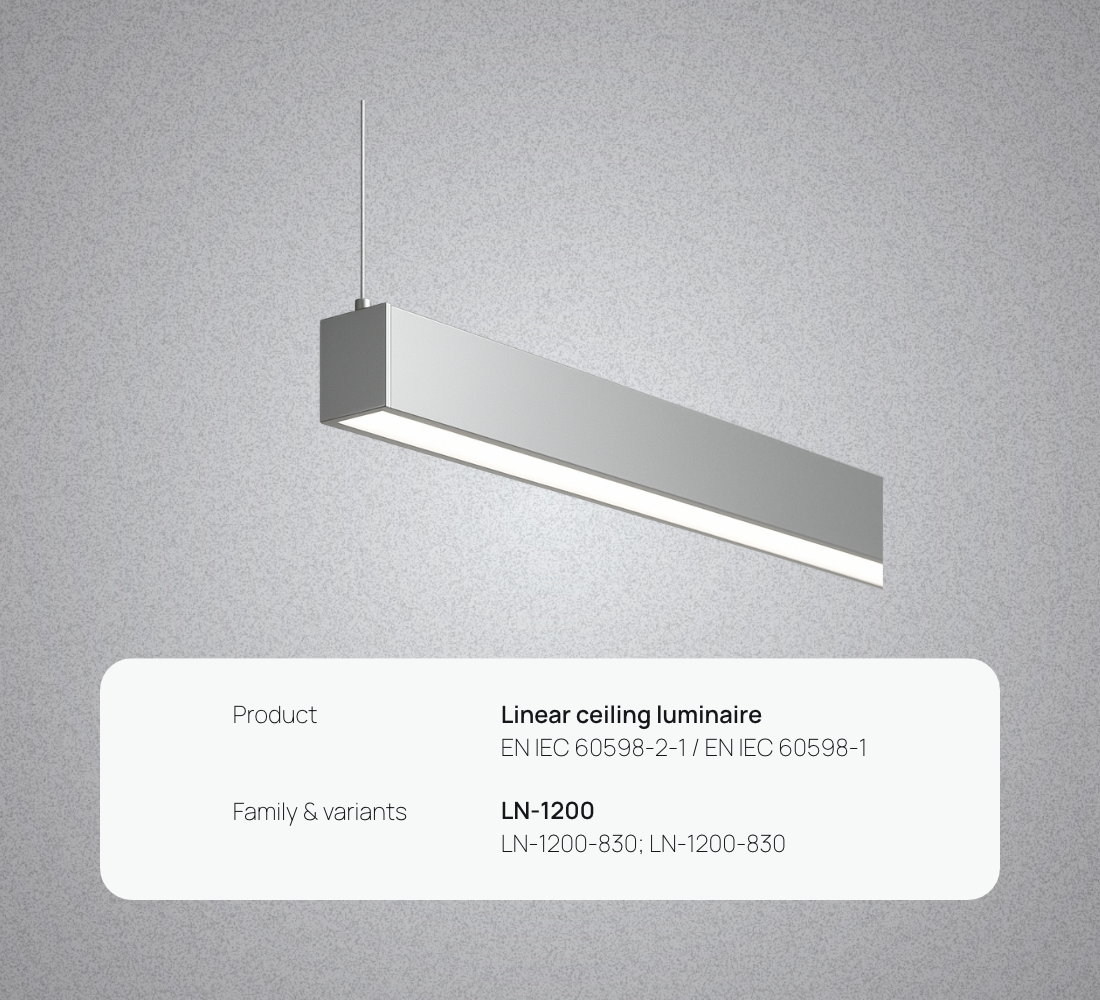
What is it, and which variants does it cover?
We identify the family, its variants, its intended use and its construction, down to components and materials. This sets which requirements apply and which products the evidence must cover.
The evidence
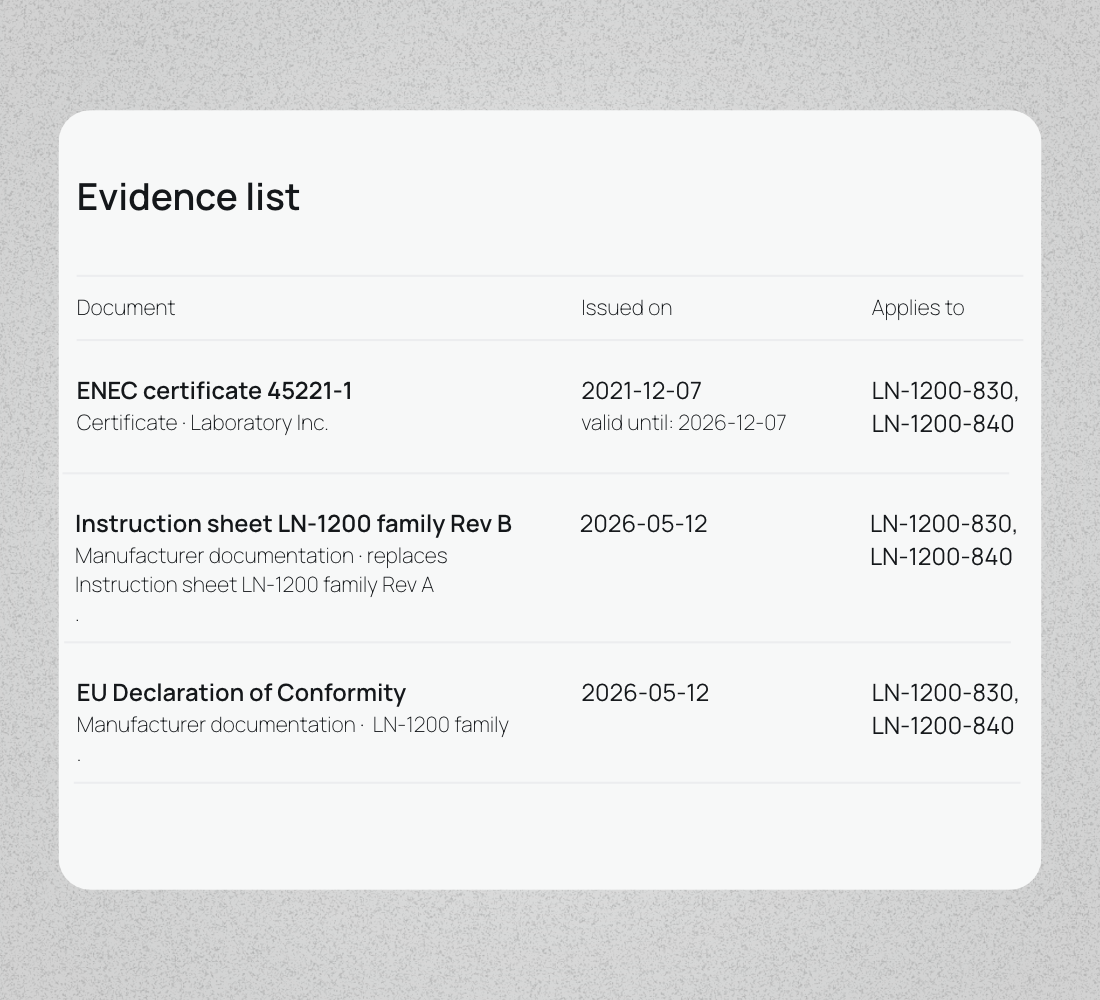
What does each document support?
We read declarations, test reports, certificates and component data, and check what each one establishes, for which variants and under which conditions.
The rules
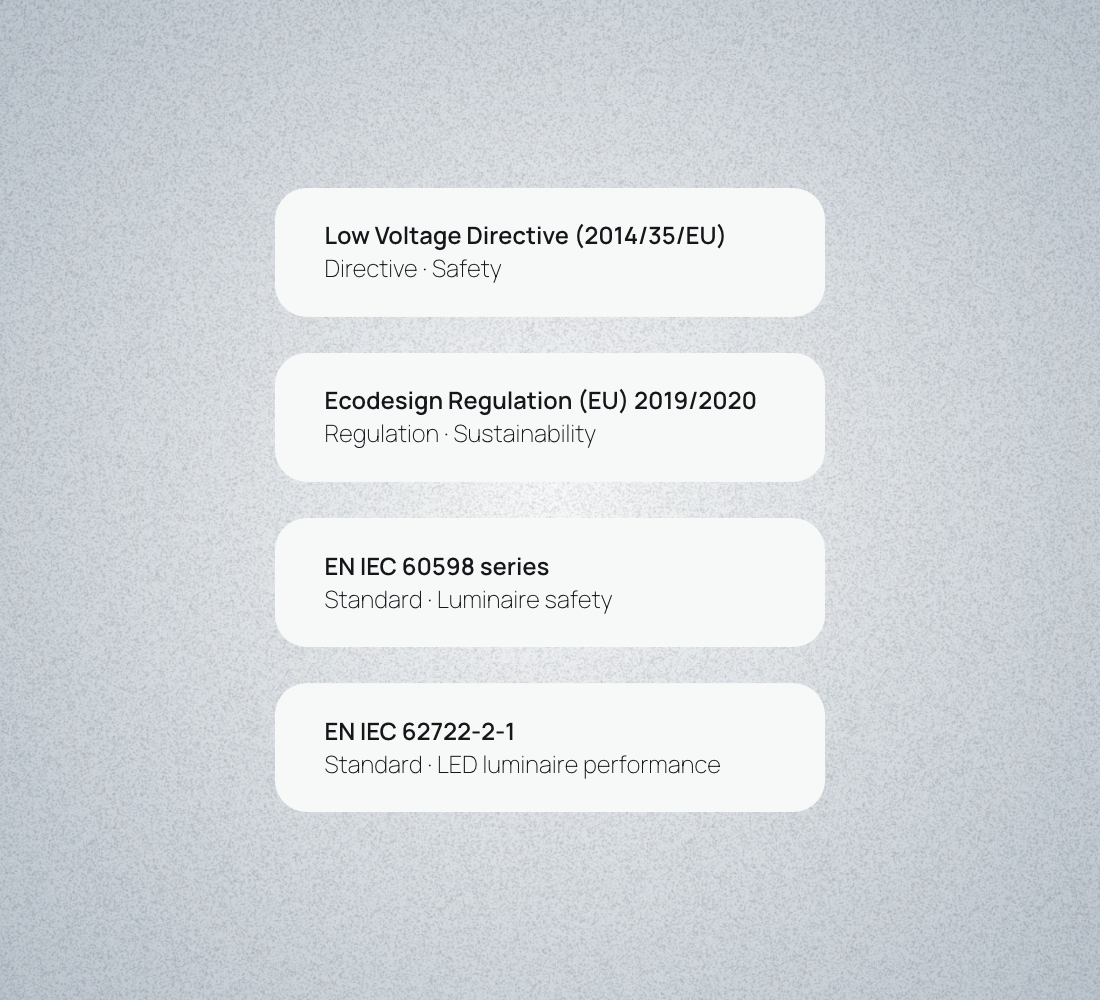
Which rules and standards apply?
Conformity is checked against each applicable EU framework. Each key value is checked against the standard or recognised method that governs it.
What each label means.
Each key value carries one label for its basis. A label tells you what a value rests on. It never judges the product.
-
A measurement on this product supports the rating, by a laboratory or by the manufacturer. The evidence shows who measured it.
-
A laboratory calculated the value from a measured sibling variant (e.g. under IEC 62722-2-1 Annex C). The evidence names the reference luminaire.
-
A valid certificate covering the product states the rating.
-
A pass result supports the rating where no certificate states it, from a laboratory or from the manufacturer's own testing.
-
A rating nothing verifies yet, such as the supply voltage. Common and legitimate.
Design facts carry the label manufacturer's information; warranties and spare parts, manufacturer's commitment; EPDs, third-party verified or manufacturer self-declared.
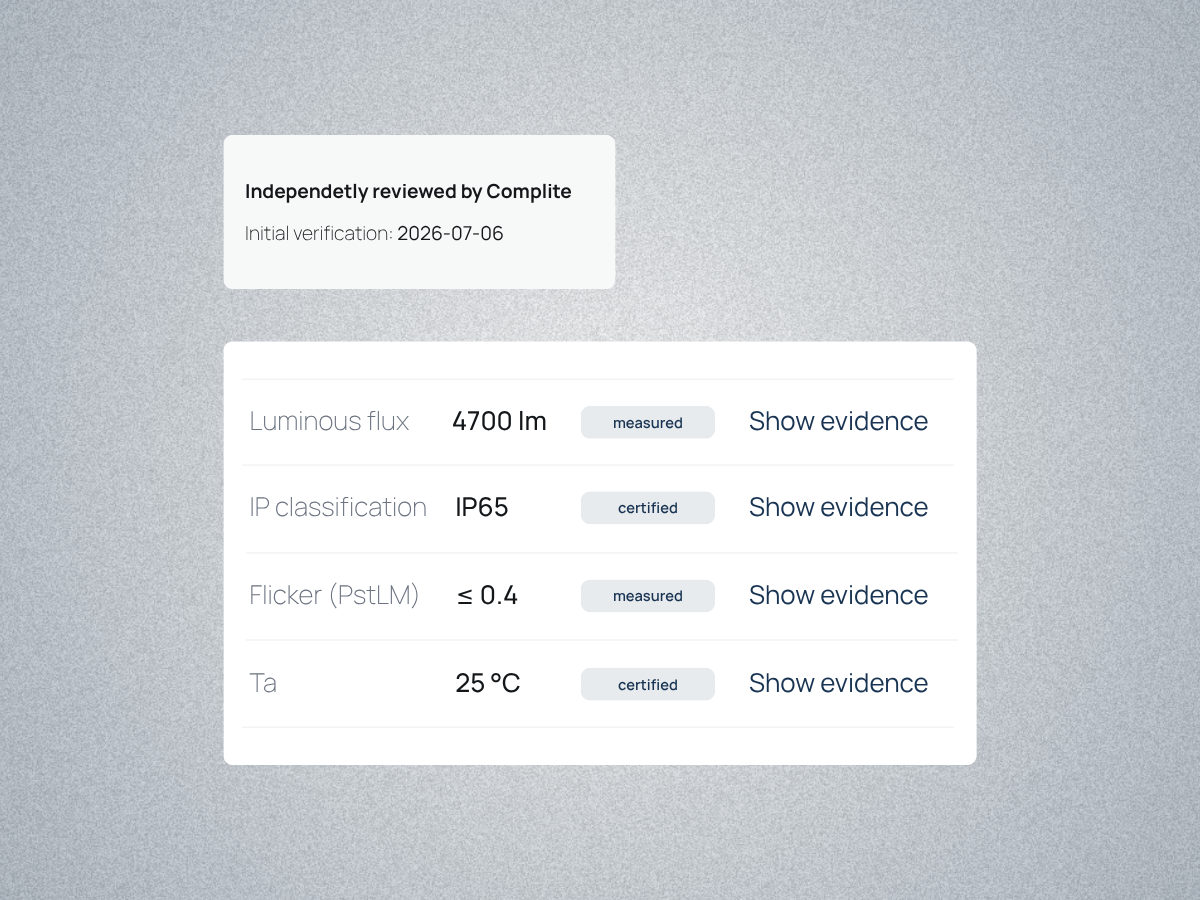
How we read the evidence.
Within its scope
A report or certificate counts only for what it covers. We check the tested sample, the variants and the conditions before a document supports a value.

The edition matters
We check which edition of a standard each document uses, and whether it matches what your declaration of conformity states.

Component values keep their basis
A value carried over from an LED module or controlgear keeps its own label. A module's lumens are never shown as the luminaire's output.
Confidential reports, read in full
We examine confidential reports in full and say so on the profile. The reports themselves are never published.


Two verification outcomes.
Verified
The review is complete, and the evidence supports conformity with every applicable regulatory framework. Verified is dated and covers a defined product family and its variants. It is not a certificate or a quality grade.
A clear list of what is needed
If something is needed, you see exactly what in the portal, private to you. You answer with more evidence or an explanation, and resubmit.
The manufacturer declares. We review what supports it.
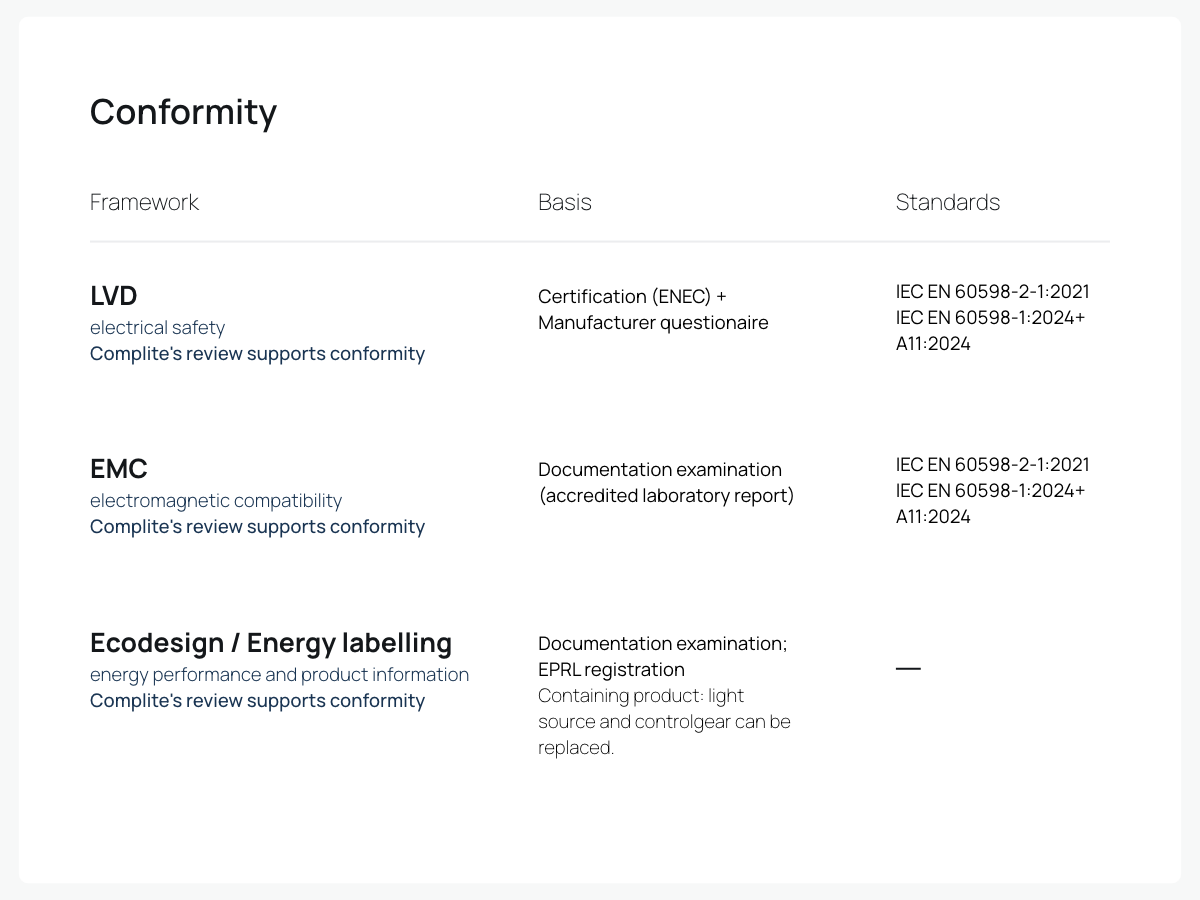
Under EU law, conformity with product legislation is declared solely by the manufacturer. We don't certify products and don't declare conformity. We examine the evidence and state whether it supports your declaration.
We do this framework by framework: LVD, EMC, RED, RoHS, Ecodesign, Energy Labelling, GPSR, REACH, the Waste Framework Directive (SCIP) and WEEE, wherever they apply.
When something changes.
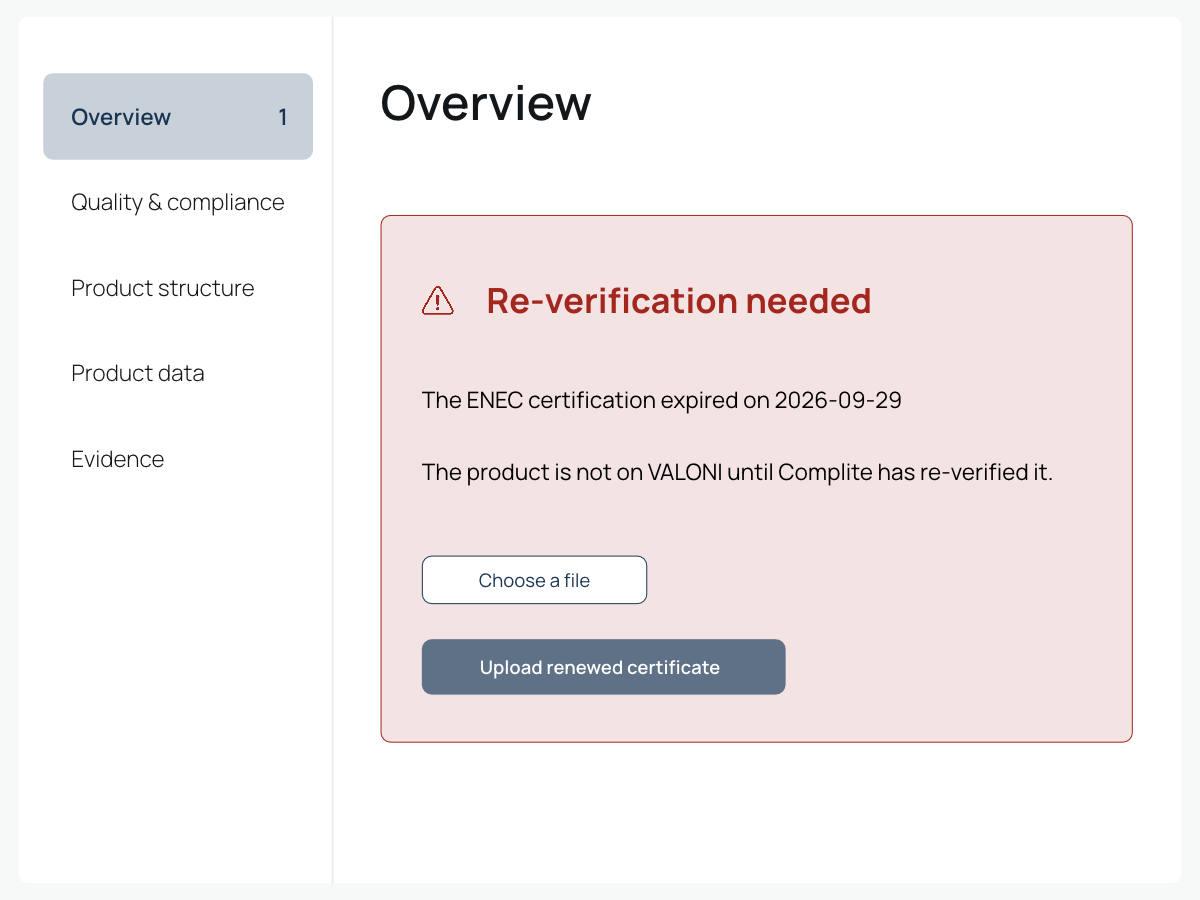
When a certificate expires, a key value changes, a variant is added, or we see a reason, the family is re-examined.
Until it is re-verified, the family is off VALONI. Its address stays the same and shows a neutral "not currently published" page, so links and QR codes keep working.
Once it is re-verified, you publish it again.
Not a grade. Not another mark.
We don't certify, score or rank products. Certificates and test reports stay the proof; we show what each key value is based on.
Bring us one product family.
We are starting with a small group of manufacturers, one product family each. Tell us which family you have in mind and what documentation you already have.