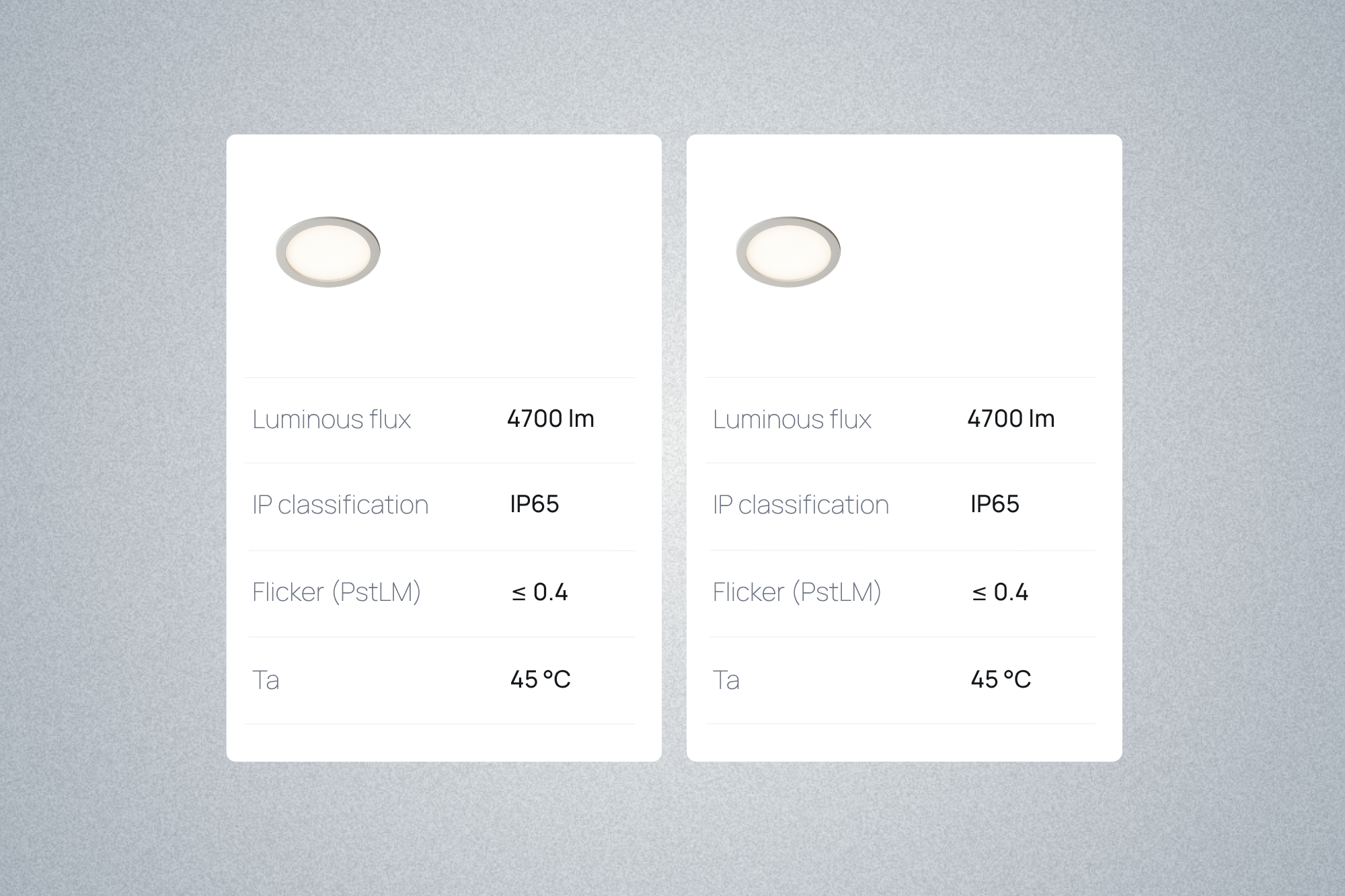
In short
Two luminaires can look identical on paper while the work behind them is very different.
The CE marking on a luminaire is the manufacturer's own declaration, so it looks the same on every product, whatever work stands behind it.
Values such as luminous flux, lifetime and IP rating rest on measurements and tests that take equipment, time and expertise, and almost none of it shows on a datasheet.
The most careful work, getting the product and its test setups exactly according to the standards, is the hardest of all to see.
The luminaire manufacturer who does the most work loses the most when the work stays invisible, because a “cheaper equal" can look like the same product.
Equals on paper
Put two luminaire datasheets side by side. Same luminous flux, same lifetime, same IP rating, the same CE marking in the corner. On paper they are equals.
Behind one of them there may be months of hard technical work: measurements of the complete luminaire, long tests in climate chamber, water and dust tests, deep diving into the standards, a technical file built line by line. Behind the other, some of that work may not have been done to the same extent.
Both can be honest documents. But nobody reading them can tell which features, values and claims rest on what.
The CE marking looks the same on every product
Before Complite, I worked for years in a testing laboratory. One part of the job was lighting product market surveillance. Every product that came in carried the CE marking, because every product was on the EU market. Quite often they had minor or moderate safety issues. From time to time there was one with a real risk of electric shock.
All of them carried the same mark.
For lighting products, the manufacturer applies the CE marking itself. It is the manufacturer's own declaration that the product meets the EU rules. No third party has to check it first. So the mark can be attached to a product whether a thorough technical file stands behind it or very little does.
The CE marking is not alone in this. Most items on a datasheet work the same way.
The work behind a few key values
Luminous flux, lifetime and IP rating appear on almost every luminaire datasheet. Each takes far more work to stand behind than its single line suggests.
Luminous flux
Knowing the luminaire's own flux, not the LED module's, means measuring the complete luminaire with a goniophotometer or in an integrating sphere. This requires special instruments and an expert's time, and both cost money. A value carried over from the module costs nothing. On the datasheet, both could be marked just "lm".
Lifetime
Nobody runs a test for 50 000 hours, let alone 100 000. Lifetime rests on accelerated tests in climate chamber, historical data, and on understanding what actually happens inside the luminaire, because the conditions there are rarely the ones the module or the controlgear was tested at. Months of testing and real cost. On the datasheet: "L80 50 000 h", the same as anyone's.
IP rating
Two digits, two test programmes: a dust chamber for one, water tests from splashing to powerful jets for the other, each with defined flow, directions and duration, in a space built for them. A rating that has been through all of that looks exactly like one that hasn't.
The work that shows the least
I have worked with manufacturers who went further than any datasheet could tell. They really put effort into understanding the standards, so that their product and their test setups would be spot on, not just to get the tests done and place the luminaire on the market.
That kind of work is the hardest to see from the outside. A test done to the letter of the standard and a test done well enough produce the same line on a datasheet. The difference sits in the setup, the choices made along the way, and the understanding of why the standard asks what it asks.
Nobody outside the company sees it. Often nobody outside the product team does either.
What it costs when the work is invisible
When the work is invisible, the market reads every datasheet the same way. That has consequences every manufacturer probably recognises:
A project lost to a “cheaper equal” that looked the same on paper.
The same work proven again in every tender, because the datasheet can't show it.
Testing and documentation budgets that are hard to defend, because their value never shows outside the company.
None of this is anyone's bad intent. It is what happens when the format that carries product data has no place for what the data is based on. This also affects the entire industry: if careful work brings no visible advantage, its cost gets harder to justify, and over time that pulls quality down across the market.
FAQ
-
No, and it isn't designed to. The CE marking on a luminaire is the manufacturer's own declaration that the product meets the applicable EU rules, and no third party has to check it first. It is required by law and looks the same on every product, so on its own it can't show how much work stands behind a particular luminaire.
-
Because the question comes up when it counts most: when a substitute is proposed, or when a tender compares values line by line. Customers rarely ask before that, because there is usually no quick way to answer. That is the moment when the work behind a manufacturer's values would matter most, and when it is hardest to see.
-
Partly. ENEC means that an independent certification body has tested the luminaire and confirmed that it meets the applicable European safety standards, and that its production is checked regularly. That is strong evidence and worth having. But ENEC covers safety (performance claims have their own mark, ENEC+). Values outside the scope of the marks a product carries still look the same on a datasheet as anyone else's, whatever work stands behind them.
-
The manufacturer who does the most work. A product with little behind its datasheet loses nothing when that work is invisible; a product with a lot behind it loses the difference. So it isn't mainly a problem for low-cost products. The more careful the testing and documentation, the bigger the cost that doesn't show.
The question worth asking
The values, features and claims on a luminaire datasheet are the visible end of a lot of work: measurements, tests, documentation, and the technical understanding behind them. For manufacturers who do that work, it is a large part of what their product is.
Little of it shows outside. Two datasheets that look the same can rest on very different work. The question worth asking is simple: based on what?
This is the question Complite helps manufacturers answer. We independently review the evidence behind luminaires, so that each key value can be shown with what it is based on.